If you’ve watched experienced pickleball players dominate matches, you’ve probably noticed that they rarely rely on powerful shots alone. Instead, they consistently use one of the most important skills in the game: the third shot drop.
For beginners, this shot can seem difficult to master. It requires touch instead of power, patience instead of aggression, and precision instead of speed. Yet once you understand how and when to use it, the third shot drop becomes one of the biggest factors in winning more doubles games.
Whether you’re new to pickleball or looking to move from beginner to intermediate level, learning this shot will dramatically improve your consistency, court positioning, and overall strategy.
In this guide, you’ll learn exactly what the third shot drop is, why it matters, how to execute it correctly, and the most effective drills to practice until it becomes second nature.
What Is the Third Shot Drop?
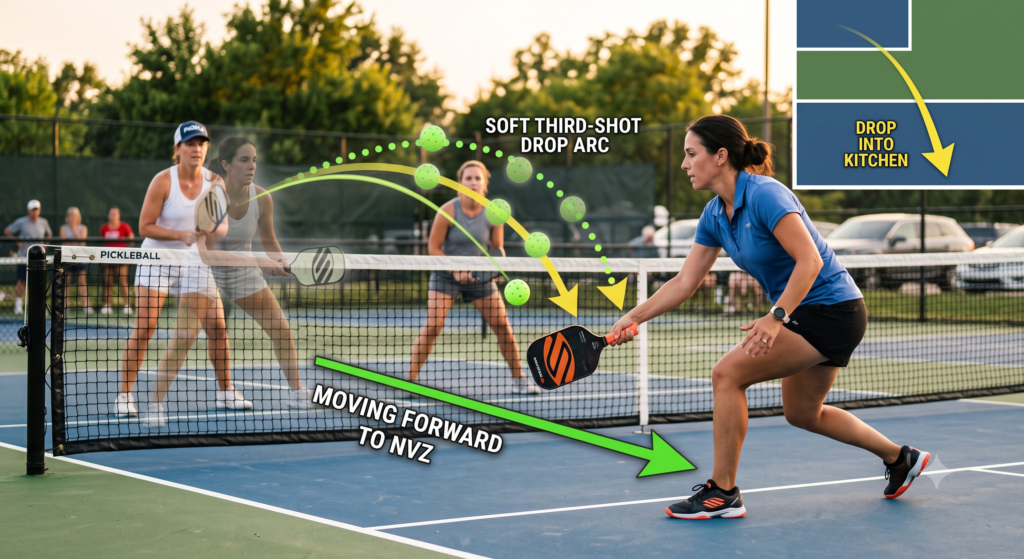
The third shot drop is a soft shot played by the serving team after the return of serve.
A typical rally follows this sequence:
- Team A serves.
- Team B returns the serve.
- Team A hits a soft shot that lands inside the opponent’s kitchen (non-volley zone).
Unlike a drive, which is designed to pressure opponents with speed, the third shot drop is intended to slow the game down and allow the serving team to move safely toward the kitchen line.
The ball should travel in a gentle arc, clearing the net by a comfortable margin before dropping into the opponent’s kitchen. Ideally, it forces your opponents to hit the ball upward, making it easier for your team to advance and take control of the rally.
Why Is the Third Shot Drop So Important?
One of the biggest disadvantages in pickleball belongs to the serving team.
After serving, both players remain near the baseline while the returning team usually advances directly to the kitchen line. Since players at the kitchen line control the net and can volley aggressively, the serving team begins each point at a positional disadvantage.
The third shot drop helps eliminate that disadvantage.
Instead of hitting a fast drive that opponents can volley aggressively, the drop shot slows the rally and gives your team enough time to move forward.
Players who consistently execute this shot gain several advantages:
- They reduce the pace of the rally.
- They force difficult upward returns.
- They create opportunities to reach the kitchen line.
- They minimize attacking opportunities for their opponents.
- They increase consistency during long rallies.
Many professional pickleball players build their entire doubles strategy around a reliable third-shot drop.
When Should You Use a Third Shot Drop?
Although the shot is called the “third shot drop,” its principles apply in several situations throughout a match.
The most common moment is immediately after your opponent returns your serve.
However, it can also be effective when:
- You are under heavy pressure.
- Your opponents are controlling the kitchen line.
- You need time to recover your court position.
- You want to reset a fast-paced exchange.
- You are forced into a defensive position.
Learning when to slow the game down is just as valuable as learning how to hit aggressive winners.
The Mechanics of a Perfect Third Shot Drop
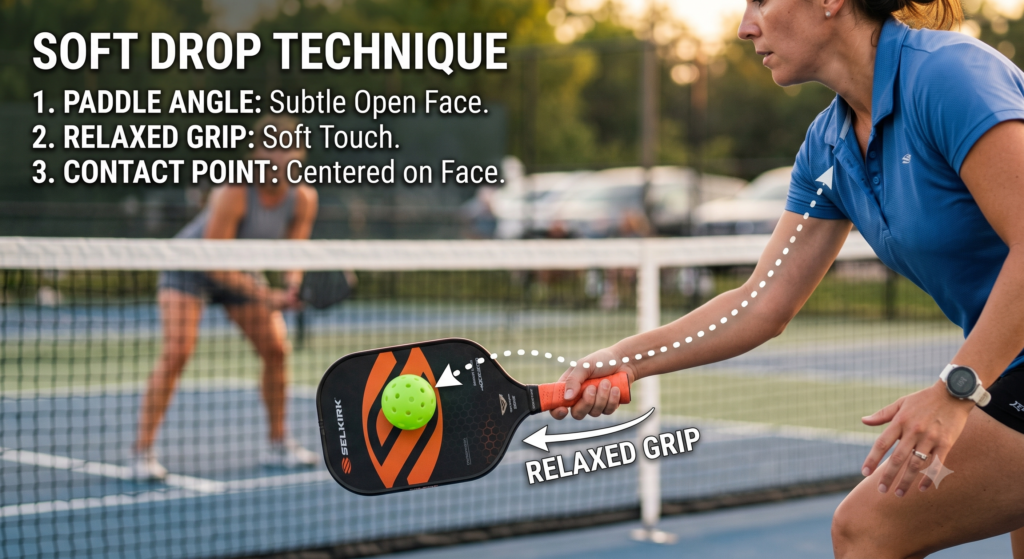
Executing a successful third shot drop is about proper technique rather than strength.
Grip
Use a relaxed continental grip or your standard pickleball grip.
Avoid squeezing the paddle too tightly. A relaxed grip provides better feel and allows you to control the pace of the shot more effectively.
Think of your grip pressure as holding a tube of toothpaste without squeezing any out.
Ready Position
Before your opponent hits the return, remain balanced with:
- Knees slightly bent
- Weight on the balls of your feet
- Paddle positioned in front of your body
- Eyes focused on the incoming ball
Good preparation leads to smoother, more controlled shots.
Footwork
Footwork often determines whether the shot succeeds or fails.
Move your feet early so you can contact the ball comfortably in front of your body.
Avoid reaching or leaning excessively.
Instead:
- Take small adjustment steps.
- Stay balanced.
- Transfer your weight smoothly from your back foot to your front foot.
- Continue moving toward the kitchen after the shot.
Efficient footwork improves both accuracy and consistency.
Paddle Angle
The paddle face should remain slightly open during contact.
This open angle helps lift the ball over the net while keeping it soft enough to land inside the kitchen.
A common beginner mistake is closing the paddle face too much, causing the ball to dive into the net.
Swing Path
The swing should be smooth and controlled.
Avoid using your wrist excessively.
Instead:
- Swing from your shoulder.
- Keep the motion compact.
- Finish naturally toward your target.
The objective is not power—it is control.
Imagine gently tossing the ball over the net rather than hitting it.
Step-by-Step: How to Hit the Perfect Third Shot Drop
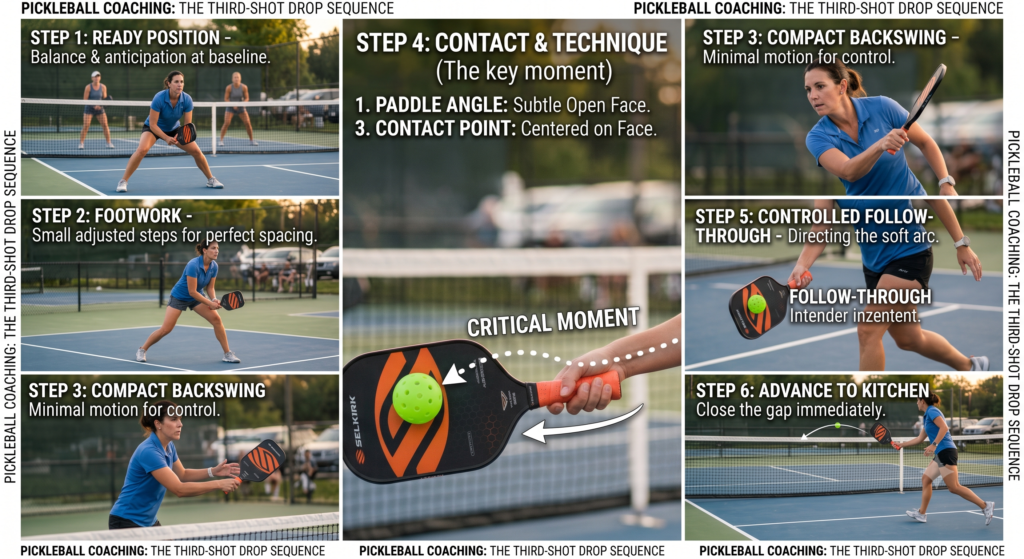
Step 1: Read the Return
Watch how deep and fast your opponent’s return travels.
A deeper return requires more lift, while a shorter return allows for easier placement.
Recognizing the ball’s trajectory early helps you prepare the correct swing.
Step 2: Move Into Position
Use quick adjustment steps rather than reaching for the ball.
Try to contact it in front of your lead foot.
Balanced positioning increases both accuracy and confidence.
Step 3: Relax Your Grip
Many beginners become tense under pressure.
Relaxing your grip allows the paddle to absorb pace naturally and improves touch.
Soft hands create soft shots.
Step 4: Lift the Ball
Brush upward through the ball using a controlled motion.
Aim for a gentle arc that clears the net by approximately two to four feet.
Trying to skim the net often leads to unnecessary errors.
Step 5: Aim for the Kitchen
Do not aim directly at your opponents.
Instead, target the center or corners of the kitchen where the ball will bounce low.
A low bounce forces your opponents to hit upward, giving your team time to advance.
Step 6: Move Forward Immediately
Your job is not finished after making contact.
As soon as you hit the drop shot, continue advancing toward the kitchen line with your partner.
Even if the drop is not perfect, moving together improves your chances of controlling the next shot.
- The most common third-shot drop mistakes
- How to decide between a drop and a drive
- Five highly effective practice drills
- Pro tips from experienced players
- Frequently Asked Questions
- An engaging ending
- Internal linking opportunities for PickleVista
Want to Master the Most Important Shot in Pickleball?
Knowing that the third-shot drop is essential is only the beginning. Learning how to execute it consistently is what separates casual players from confident competitors. Discover the complete step-by-step guide, common mistakes to avoid, and practice drills that will help you master this game-changing shot.
Read next: How to Hit the Perfect Third Shot Drop in Pickleball (Step-by-Step Guide)