Pickleball has become one of the fastest-growing sports in the world, attracting players of all ages and skill levels. Its combination of tennis, badminton, and table tennis creates a unique experience that is easy to learn yet challenging to master. Whether you’re stepping onto a pickleball court for the first time or looking to understand the fundamentals before joining a game, learning the rules is the perfect place to start.
Many beginners are surprised by how quickly they can pick up the basics. However, understanding the official rules will help you play confidently, avoid common mistakes, and enjoy the game from day one.
In this guide, you’ll learn everything you need to know about pickleball rules, scoring, serving, court zones, and gameplay essentials.
What Is Pickleball?
Pickleball is a paddle sport played on a court that resembles a smaller tennis court. Players use solid paddles and a perforated plastic ball, often called a wiffle ball.
The game can be played as the following:
- Singles (1 vs. 1)
- Doubles (2 vs. 2)
While singles is growing in popularity, doubles remains the most common format because it is social, strategic, and less physically demanding.
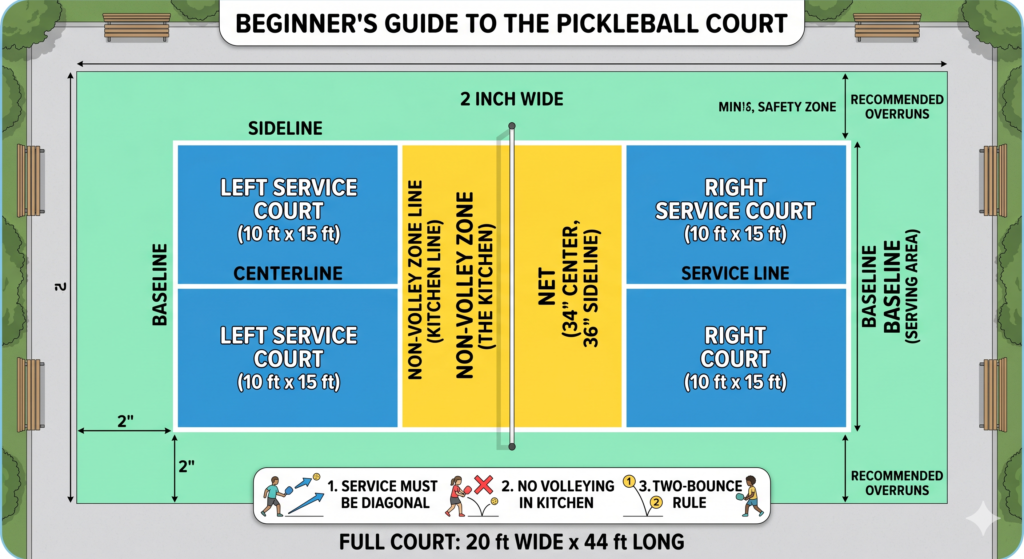
Understanding the Pickleball Court
Before learning the rules, it’s important to understand the court layout.
Court Dimensions
A standard pickleball court measures the following:
- 20 feet wide
- 44 feet long
These dimensions are the same for both singles and doubles.
Key Areas of the Court
Baseline
The line at the back of the court.
Sidelines
The lines running along the sides of the court.
Centerline
Divides each side of the court into right and left service courts.
Non-Volley Zone (The Kitchen)
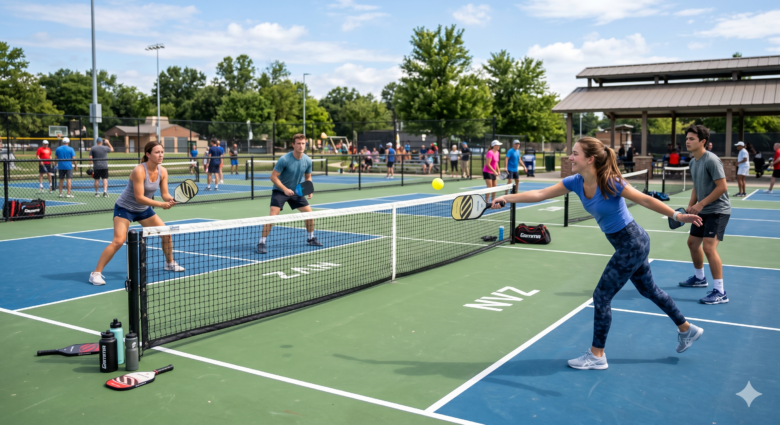
The most unique part of pickleball is the non-volley zone, commonly known as the kitchen.
This area extends 7 feet from the net on both sides.
Players cannot volley the ball while standing inside the kitchen.
Understanding this area is crucial because many beginner mistakes occur here.
Equipment Needed to Play
One reason pickleball has become so popular is that it requires minimal equipment.
Essential Equipment
- Pickleball paddle
- Pickleball ball
- Court with a net
- Athletic shoes
Beginners should focus on comfort and control rather than purchasing expensive professional gear immediately.
How a Pickleball Game Begins
Every game starts with a serve.
The serving team determines who serves first and begins from the right-hand service court.
The ball must be served diagonally across the net into the opponent’s service court.
If the serve lands correctly, the rally begins.
Pickleball Serving Rules
Serving is one of the most important aspects of the game.
Basic Serving Rules
The server must:
- Stand behind the baseline
- Hit the ball underhand
- Contact the ball below waist level
- Serve diagonally into the opposite service court
The serve cannot land in the kitchen.
If it does, it is considered a fault.
One Serve Attempt
Unlike tennis, players only get one serve attempt.
Missing the serve results in a fault.
Serving Position
The score determines where the server stands.
- Even score = serve from the right side
- Odd score = serve from the left side
This rotation continues throughout the game.
The Two-Bounce Rule Explained
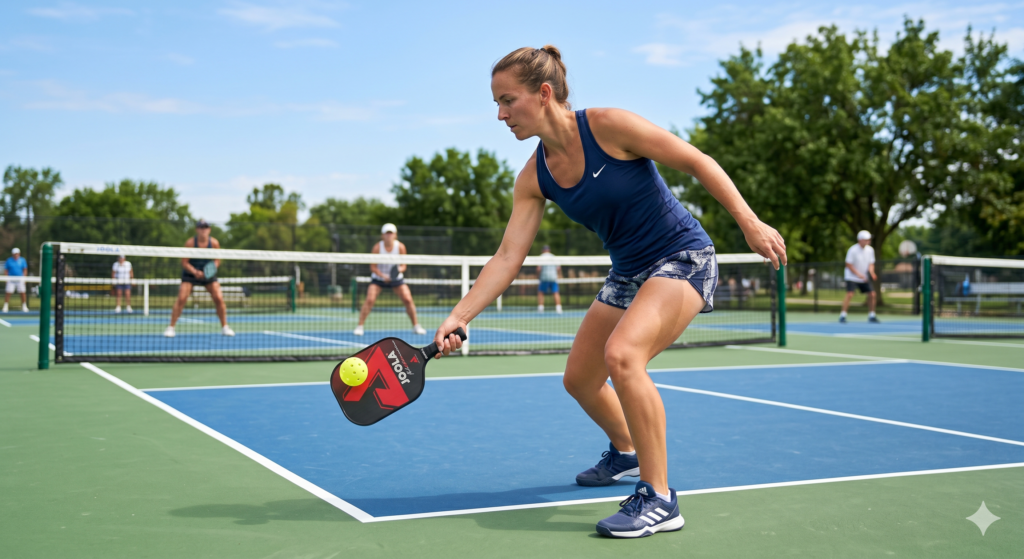
The two-bounce rule is one of the most important pickleball rules for beginners.
How It Works
- The serving team serves.
- The receiving team lets the ball bounce once before returning it.
- The serving team must also let the return bounce once.
- After those two bounces, either team may volley or play the ball after a bounce.
Why This Rule Exists
The two-bounce rule prevents the serving team from rushing the net immediately and encourages longer rallies.
For new players, remembering this rule can dramatically reduce unnecessary faults.
Understanding the Kitchen Rule
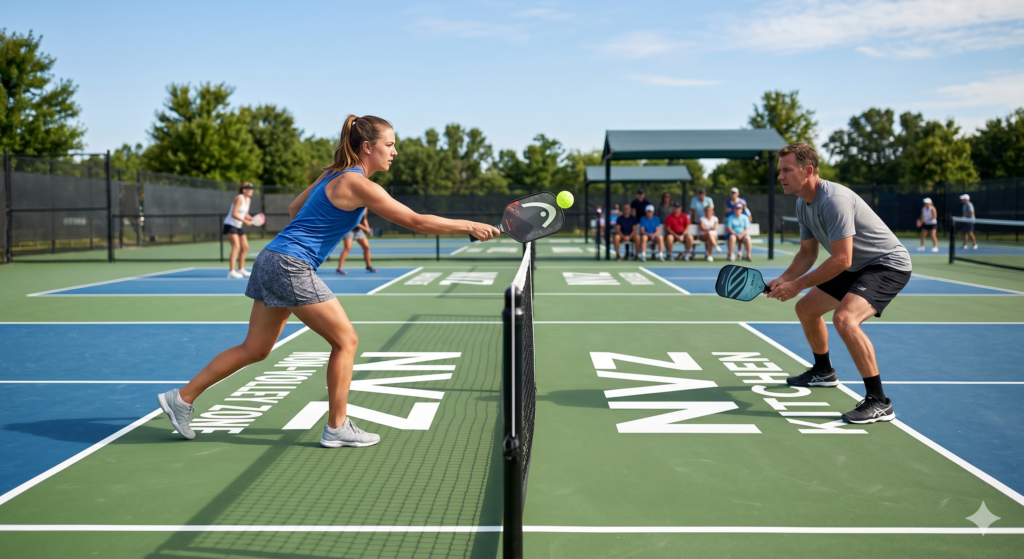
The kitchen often confuses new players more than any other rule.
What Is a Volley?
A volley occurs when a player hits the ball before it bounces.
Kitchen Restrictions
Players cannot:
- Volley while standing inside the kitchen
- Step into the kitchen during a volley
- Have momentum carry them into the kitchen after a volley
What Players Can Do
Players may enter the kitchen if:
- The ball has bounced first
- They are retrieving a short shot
Once the play is complete, they may return to another position on the court.
Mastering the kitchen is one of the biggest steps toward becoming a better pickleball player.
How Scoring Works in Pickleball
Scoring is often the most intimidating part for beginners.
Fortunately, it becomes easy after a few games.
Traditional Scoring
Most recreational and tournament games are played to:
- 11 points
- Win by 2 points
Some tournament matches may use:
- 15 points
- 21 points
Only the Serving Team Scores
Unlike many sports, only the serving side can earn points.
If the receiving team wins a rally, they gain the serve but not a point.
Calling the Score
In doubles, three numbers are announced.
For example:
4-2-1
This means:
- The serving team has 4 points
- The receiving team has 2 points
- First server is serving
The third number identifies which server is serving during doubles play.
Doubles Rules Explained
Most beginners start with doubles.
Server Rotation
Each player on a team gets an opportunity to serve before the serve switches to opponents.
The only exception occurs at the very beginning of the game.
Partner Positioning
Partners usually work together by:
- Covering their side of the court
- Communicating on shots
- Moving toward the kitchen line after the two-bounce sequence
Successful doubles teams rely heavily on positioning and teamwork.
Singles Rules Explained
Singles uses the same court dimensions but follows slightly different movement patterns.
Key Differences
- Players cover the entire court alone
- Greater emphasis on speed and endurance
- More passing shots and deep returns
Serving positions still follow the odd-even scoring system.
When a player’s score is even, they serve from the right side.
When odd, they serve from the left side.
Common Faults in Pickleball
A fault stops play immediately.
Understanding faults helps beginners avoid giving away easy points.
Common Faults Include
Hitting the Ball Out of Bounds
If the ball lands outside the court lines, it is out.
Missing the Ball
Failing to return the ball before the second bounce results in a fault.
Serving Into the Net
Any serve that fails to clear the net is a fault.
Kitchen Violations
Volleying while in the kitchen or entering the kitchen due to momentum after a volley results in a fault.
Violating the Two-Bounce Rule
Hitting the ball before the required bounce sequence is completed causes a fault.
Step-by-Step Guide to Playing Your First Match
If you’ve never played before, follow these simple steps.
Step 1: Learn the Court Layout
Identify:
- Baseline
- Sidelines
- Service courts
- Kitchen
Step 2: Practice Basic Serves
Focus on:
- Underhand motion
- Accuracy
- Consistency
Power can come later.
Step 3: Understand the Two-Bounce Rule
Practice allowing the first two shots to bounce.
This will quickly become second nature.
Step 4: Move Toward the Kitchen Line
After the bounce sequence, move closer to the kitchen line for better court coverage.
Step 5: Focus on Keeping the Ball In Play
Beginners often try to hit winners too early.
Consistency usually beats power.
Step 6: Learn the Score Calling System
Understanding scoring makes games more enjoyable and less confusing.
Step 7: Play Regularly
The fastest way to improve is simply getting on the court and playing.
Beginner Tips for Faster Improvement
Keep Your Paddle Up
A ready position allows quicker reactions.
Stay patient.
Long rallies are common in pickleball.
Avoid rushing shots.
Communicate in Doubles
Talk with your partner regularly.
Clear communication prevents confusion and missed shots.
Watch Experienced Players
Observing skilled players can teach positioning and strategy much faster than reading rules alone.
Practice Dinking
A dink is a soft shot that lands in the opponent’s kitchen.
This shot becomes increasingly important as skill levels rise.
Why Pickleball Is So Easy to Learn
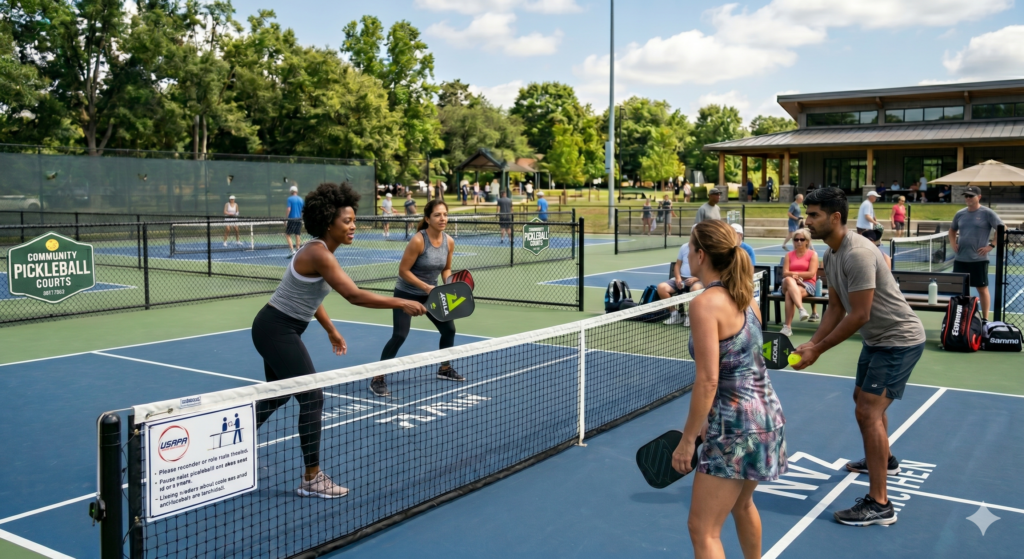
One of pickleball’s greatest strengths is accessibility.
The smaller court reduces running.
The underhand serve lowers the learning curve.
The lightweight paddle is easy to control.
Most beginners can enjoy competitive rallies within their first session, which is one reason the sport continues to attract millions of new players every year.
The rules may seem overwhelming at first glance, but once you understand serving, scoring, the two-bounce rule, and the kitchen, everything begins to make sense. After a few matches, these fundamentals become second nature, allowing you to focus on strategy, teamwork, and enjoying the game itself.
Every experienced pickleball player was once a beginner standing on the court wondering where to serve, how to keep score, and why everyone kept talking about the kitchen. The good news is that the learning curve is surprisingly friendly. Grab a paddle, find a local court, and put these rules into practice. Before long, you’ll discover why pickleball has become one of the most addictive and enjoyable sports in the world.